Smaller jurisdictions often face unique challenges: leaner teams, tighter budgets, and increasing demand for transparency, engagement, and speed.
For Chanhassen, Minnesota — a city with approximately 85 full-time staff — embracing AI was less about tech buzzwords and more about creating capacity in their organization.
Like many smaller jurisdictions, Chanhassen, Minnesota — a city of 26,000 residents with 85 full-time staff—faces the challenge of doing more with less. For Assistant City Manager Matt Unmacht, adopting AI wasn’t about buzzwords; it was about creating capacity.”
While general-purpose tools sparked interest, they lacked the specificity and safety that local government needed. Madison AI offered a tailored solution: an AI model trained only on Chanhassen’s documents of authority and built specifically to tackle their everyday work.

Matt Unmacht, Assistant City Manager
While general-purpose tools sparked interest, they lacked the specificity and safety that local government needed. Madison AI offered a tailored solution: an AI model trained only on Chanhassen’s documents of authority and built specifically to tackle their everyday work.
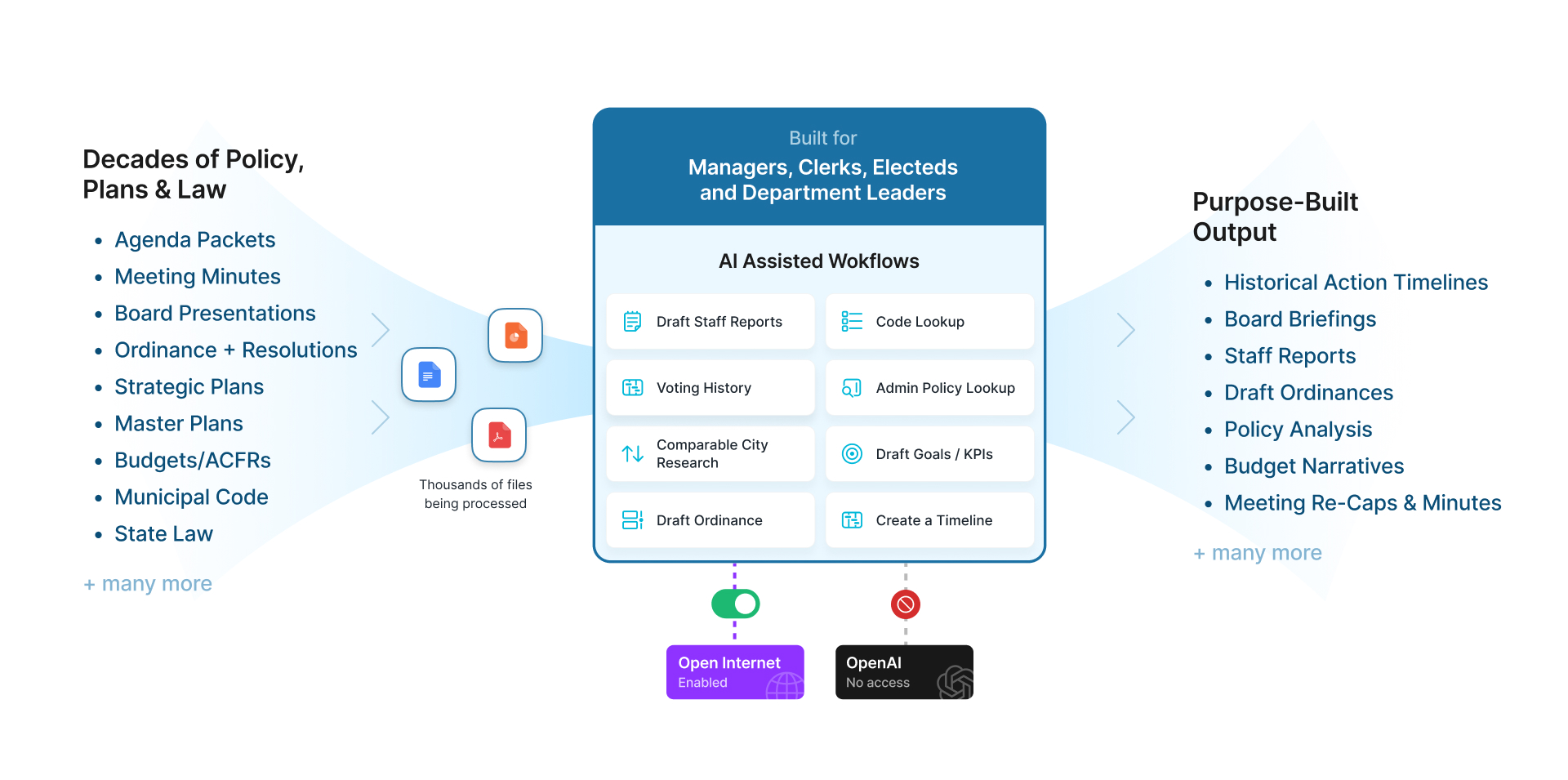
We built an AI model and purpose-built agents for the City of Chanhassen to support the Administration and Governance workflows for everyday work for:
- City Management
- Clerks
- Department Leaders
- Electeds
This isn’t a generic chatbot. It’s a purpose-built, custom AI model designed to tackle everyday work, like drafting staff draft reports, answering policy questions, looking up past decisions, and accessing institutional knowledge—quickly and accurately.
What does it actually look like to use AI in local government? In Chanhassen, it means applying Madison AI to everyday work, like writing reports, looking up past decisions, or researching peer cities.
Here are 3 validated use cases that show where Madison AI is delivering real impact in Chanhassen today.
Staff reports are key in helping leaders make informed decisions by providing clear analysis and thoughtful recommendations. Madison AI speeds up the process by handling data gathering, drafting, and formatting so that staff can spend more time on strategy and insight.
Dig through years of PDFs and memos
Re-summarize previous decisions.
Format everything from scratch.
Review, revise, and rewrite to include more information.
Senior-level review and revisions before submitting.

Enter your report subject and context
Receive a draft with citations from historical documents
Workshop with AI
Senior-level review, edits, and approval

When experienced planners and knowledge workers retire, their knowledge doesn’t need to leave with them. Madison AI electrifies document archives and allows staff to search historical decisions, projects, and council items instantly, cutting research time from hours to minutes.
Ask long-tenured staff (if they’re still around) for information.
Hunt through documents, files, and other disconnected files.
Piece together timelines manually.
Have senior staff review.
Complete more research in archive file.
Draft your findings and recommendations.
Type a question about any project, district, or topic covered in your city.
Get a timeline, background, and citations in seconds.
Review the information and draft your findings or recommendations.
Matt Unmacht, Assistant City Manager
Instead of time-consuming outreach to other cities, Chanhassen uses Madison AI to pull examples of policies developed by neighboring communities, halving the time needed to draft recommendations.
E-mail peer cities and wait for replies
Manually gather and synthesize documents
Receive information from other cities, and request more documentation
Synthesize findings
Build recommendations from scratch
Research internal + other neighboring cities data simultaneosly
Receive comparison summaries with web-linked resources
Outreach to pre-defined cities
Build informed recommendations faster
Chanhassen’s journey with Madison AI proves that AI isn’t a future concept—it’s a practical tool making a real impact today.
Chanhassen has shown how AI can remove the administrative burden and let staff focus on what matters. With an approach rooted in responsible adoption, real use cases, and a strong feedback loop, the city has created a model that’s scalable, secure, and staff friendly.
The result? More informed decisions, faster workflows, and real-time savings for their cities. What could you do with 160+ hours of additional staff time every month?